
 |
|---|
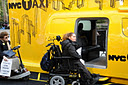
Forget about getting around New York City if you're in a wheelchair. About two percent of more than 13,000 yellow cabs are accessible. (Compare us to London, where every taxi can handle wheelchairs.)
What's holding New York up?
The taxi industry is resisting accessible cabs - just like the auto industry resisted seat belts, airbags and higher fuel economy. But the City regulates 100% of the taxi industry. So it's time for a mandated, gradual conversion to accessible vehicles for the entire fleet. Otherwise, 49 out of every 50 yellow cabs in the fleet will remain out of reach for most wheelchair users.
Thank you all for your interest in the TLC hearing on the proposed rule change that would have resulted in at least 50 percent of yellow taxis be wheelchair accessible by 2020. We have been told it was postponed because there is no Chair of the TLC at this time (David Yassky left on December 31, 2013). The Taxi For ALL Campaign is very concerned about the delay.
Unfortunately, the deadline for written comment remains January 22, 2014. (We think it is as crazy as you do!)
Therefore, we hope you will submit your written testimony
-- Edith Prentiss, Chair of Taxis for ALL Campaign
December 6, 2013
CITY OF NEW YORK AND DISABILITY ADVOCATES ANNOUNCE
LANDMARK SETTLEMENT TO DRAMATICALLY
INCREASE NYC TAXICAB ACCESSIBILITY
One out of every two medallion taxicabs
will be wheelchair accessible by 2020
 Press Release as a PDF document
(Link opens in a new browser window)
NEW YORK, NY Four disability rights organizations, the New York City Taxi and Limousine Commission (TLC) and the Mayor's Office for People With Disabilities (MOPD) announced today that they have reached an historic settlement agreement to phase-in wheelchair accessible yellow medallion taxicabs so that fifty percent (50%) will be accessible to men, women, and children who use wheelchairs and scooters by 2020. The agreement is the first of its kind in the country and would make New York's yellow taxi fleet the most accessible in the nation and one of the most disability-friendly in the world.
The agreement calls for the TLC to propose rules that, if approved following a public hearing to be held next year, will require yellow taxi fleets to replace, via attrition, at least 50-percent of taxicab vehicles with wheelchair accessible vehicles by 2020. New York City taxicabs typically have a lifespan of three to five years, depending on how they are operated, and the 2,000 new taxicab medallion licenses that will be issued over the next several years (200 of which have already been auctioned) will count toward the 50% goal. The rulemaking process will determine how the remaining number will be achieved.
"New York is a world class city. Now it will also have a world class taxi system,"
said Sid Wolinsky of Disability Rights Advocates. "This will make New York a more livable city for tens of thousands of residents and visitors alike."
"For too long, wheelchair users have lacked adequate access to this crucial part of New York's transportation network,"
said TLC Commissioner and Chair David Yassky. "We at the TLC are thrilled to be able to right this longstanding flaw in a taxi system that is otherwise a source of so much pride for New York."
Currently, only 231 out of the City's 13,237 taxicabs are wheelchair-accessible. In June 2012, the City established a dispatch program enabling wheelchair users to request accessible taxicabs via 311. "The dispatch program has helped thousands of wheelchair users get a taxi, but it is not enough. Today's agreement will bring us a truly accessible taxi fleet,"
Yassky said.
"It is my office's goal to make New York City the most accessible and inclusive city in the world, and this landmark agreement significantly furthers this mission," said MOPD Commissioner Victor Calise. "MOPD has worked side by side with City agencies and advocates to help make this historic day a reality. We are excited to see the results of this agreement and look forward to its implementation setting an example for the rest of the country to follow."
"We're overjoyed that the City has finally seen fit to treat us fairly,"
said Edith Prentiss, chair of the Taxis For All Campaign, now the named plaintiff in the lawsuit. "We believe this historic pact will soon make a huge difference for people who use wheelchairs not only here in New York City but across the country."
"I am gratified that all the parties to the litigation were able to resolve their differences and move forward in a way that is good for all New Yorkers and visitors,"
said NYC Corporation Counsel Michael A. Cardozo.
"Today's historic agreement ensures that this service, taken for granted by so many, is afforded to all New Yorkers,"
said TLC Commissioner Frank Carone. "By ensuring that 50 percent of our taxi fleet is wheelchair accessible, our City has demonstrated once again that we take care of those most in need and are on the forefront of progressive issues. New York City has always been a model for the rest of the world, and I am hopeful that today's announcement will serve as an example for other cities around the globe."
"I have long believed that the TLC must do a better job at providing sufficient access to taxis to people with disabilities, particularly those who use wheelchairs,"
said TLC Commissioner LaShann DeArcy. "The solution to this complicated issue could only be reached, however, through the collaborative efforts of the TLC, the disabled community, and other constituencies. This settlement marks the culmination of our collective efforts and represents a sea change in wheelchair accessibility in New York City. It is a win for all of us."
"This is a milestone agreement that I am proud to support,"
said TLC Commissioner Elias Arout. "Once again, New York City leads the way in public service and caring."
"Finally, a monumental step has taken place
.equality for all,"
said TLC Commissioner Lauvienska Polanco. "Thanks to all involved, especially Chairman Yassky, TLC staff and City Hall for such a courageous move toward integrating all sectors of the riding public. Bravo!"
"I would like to extend both acknowledgement and thanks for the hard work of Disability Rights Advocates, the Mayor's Office for People with Disabilities, the New York City Corporation Counsel's Office and Taxi and Limousine Commission staff for reaching a balanced landmark settlement,"
said TLC Commissioner Edward Gonzales. "I look forward to working with the industry, vehicle manufacturers and retrofitters in implementing enhanced accessible taxi service for New York City."
Assuming the proposed disability rules are adopted by the Taxi and Limousine Commission following a public hearing, the settlement, upon approval by the federal court, will resolve a federal class action lawsuit filed in January 2011 in the U.S. District Court for the Southern District of New York. The suit was brought by a coalition of people with disabilities, including Taxis for All Campaign, United Spinal Association, 504 Democratic Club, and Disabled in Action.
Plaintiff Simi Linton, a lifelong New Yorker and power wheelchair user said, "Especially in New York, the ability to travel in a taxi is vital for getting to work, medical appointments, and cultural events. It's critical in emergencies. This is a victory worth celebrating this holiday season."
James Weisman, general counsel for Plaintiff United Spinal, added that "this is going to save the City tens of millions a year in paratransit costs. Making cabs accessible is not just the sensible thing to do for the many New Yorkers and visitors to the City who use wheelchairs, it's fiscally responsible."
The matter is titled Taxis for All Campaign v. Taxi & Limousine Commission (TLC), and was formerly captioned Noel v. TLC. Under the settlement terms, the TLC agrees to propose rules that, once approved following a public hearing to be held next year, will require the yellow taxi fleet to phase-in wheelchair-accessible vehicles, as non-accessible taxis are retired, reaching a 50-percent wheelchair accessible fleet by 2020.
The disability groups are represented by Sid Wolinsky, Julia Pinover, and Kara Janssen of the nonprofit legal center Disability Rights Advocates and Daniel Brown and Sara Aberg of Sheppard Mullin Richter & Hampton LLP. The City is represented by Robin Binder and Michelle Goldberg-Cahn of the Office of the Corporation Counsel of New York City.
Grand Limo and Car Service Inc.
3607 32nd Street
Astoria, NY 11106
(718) 433-4255
Federal Transit NY Inc.
924 64th Street
Brooklyn, NY 11219
(718) 688-2288
Riverside Radio Dispatcher
1642 St. Nicholas Avenue
New York, NY 10040
(212) 923-1111
First Class C/L SVC Corp.
4980 Broadway
New York, NY 10034
(212) 304-1111
V.I.T. Car Service, Inc.
1478 White Plains Road
Bronx, NY 10462
(718) 904-8057
American Base No. 1 Inc.
522 East 149th Street
Bronx, NY 10455
(718) 665-6664
Statement of Edith Prentiss, chair, Taxis For All Campaign
on the TLC's latest vote to approve the Nissan NV200
June 20, 2013
Once again, the Taxi and Limousine Commission has shamefully voted to shut out people with disabilities.
By approving the so-called Taxi of Tomorrow for a 10-year contract, Chairman David Yassky, seven of his TLC colleagues and City Hall have made sure tens of thousands of wheelchair users won't have access to a vital part of New York's transportation network. Many others with mobility issues will lose out as well.
The Nissan NV200 is a van and, when brought into service, will violate Americans with Disabilities Act rules which prohibit the use of vans as taxis if they are not accessible. We are suing the TLC over this question, but the city chose to go ahead with its taxi of yesterday nevertheless.
In London, every taxi is accessible. In New York, we are moving backward. In the end, though, fairness and common sense will prevail.
For more information, contact Edith Prentiss
Statement of Edith Prentiss, chair, Taxis For All Campaign
on withdrawal of accessible taxi proposal
May 18, 2013
The Taxis For All Campaign is very disappointed that the City Council will not vote on Intro. 433-A, Council Member Koppell's proposal for a gradual transition to an 100 percent accessible yellow-taxi fleet. The bill had a veto proof majority of sponsors.
Unfortunately, this week the Council Member had decided to move forward with a much different proposal than Intro. 433-A, in part because Speaker Quinn would not support Intro. 433-A. His new proposal would have made the accessibility requirement null and void if the cost of running an accessible taxi was 5 percent or higher than a non-accessible taxi. That's a loophole big enough to drive a fleet of cabs through.
The Council's new bill put a price tag on civil rights, which no one should accept. However, we did suggest the Council include a way of mitigating the cost of accessible taxis so that higher costs to taxi purchasers would be offset -- a reasonable proposal that has support in the taxi industry. However, Council Member Koppell and, apparently, Speaker Quinn rejected this approach.
This is not over. Under Speaker Quinn, the number of accessible taxis has remained stuck at about 231 since 2007 out of 13,237 taxis. That's a record that must change.
For more information, contact Edith Prentiss
Statement of Edith Prentiss, Chair of Taxis For All Campaign
December 14, 2012
Comptroller Liu's bold decision to reject the Taxi of Tomorrow contract is smart, fair and the right thing to do. In a city that strives for innovation and equality, the city proposes instead to introduce a non-accessible taxi that violates federal Americans with Disabilities law and would leave tens of thousands of New Yorkers and visitors at the curb. Mayor Bloomberg and David Yassky's reluctance to accommodate all citizens is a throwback to the days we all should be eager to leave behind.
The mayor has foolishly dismissed Liu's action, but we stand with the comptroller and are prepared to return to court if necessary. We also call on Speaker Quinn to take action now in the City Council to require all taxis to be wheelchair-accessible.
For more information, contact Edith Prentiss
Statement of Edith Prentiss, Taxis For All Campaign
on TLC approval of "Taxi of Tomorrow"
September 20, 2012
This is a giant roll-back for equal access and fair play, not a leap forward.
TLC Commissioner Yassky and his colleagues had a real chance to make our taxi system accessible, as London's has been since 1989. But Yassky instead chose a 'Taxi of Yesterday'
-- a technologically backward vehicle that can't even be made accessible without an expensive retrofit. Now it's time for Speaker Quinn and the City Council to act and ensure that everyone can use our city's taxis.
In response to the January 5, 2012 Op-Ed article by Matthew Daus, "Hailing the Wrong Taxi"
From the New York Times
To the Editor:
Matthew W. Daus doesn't pay attention to the needs and rights of people with disabilities. The new taxi legislation announced by Governor Andrew M. Cuomo and Mayor Michael R. Bloomberg last month that would put 2,000 wheelchair-accessible cabs on the streets will not only benefit wheelchair users but also aging baby boomers and returning veterans. If London can run a 100 percent accessible fleet, so can New York City.
Mr. Daus says "many disabled riders would far prefer home pickup to an uncertain wait on a corner in bad weather"
; he is out of touch with a population that has been working to secure the same rights for street hails that able-bodied citizens have.
The city tried a dispatch system, as he notes, and it failed miserably. Mr. Daus now wants the city to go back into the dispatch business when it can simply require new taxis to be accessible.
The new legislation will not force taxpayers to "foot the bill"
but will save them hundreds of millions by reducing demand for Access-a-Ride, the Metropolitan Transportation Authority's $462 million-a-year, $50-a-ride cost to taxpayers. Benefits-related travel made by people in wheelchairs sponsored by the Department of Veterans Affairs and Medicaid could be made at far less expense by accessible taxi than by ambulette.
Mr. Daus's failure to provide meaningful service to people with disabilities is the reason a lawsuit and legislation were required.
JAMES WEISMAN
Senior Vice President and General Counsel
United Spinal Association
East Elmhurst, Queens, January 5, 2012
LANDMARK DECISION: NEW YORK CITY TAXI AND LIMOUSINE COMMISSION'S OPERATION OF INACCESSIBLE TAXI FLEET DISCRIMINATES AGAINST NEW YORKERS WITH DISABILITIES
December 23, 2011
New York, NY December 23, 2011 In a major victory for wheelchair users, a Federal Court ruled today that the New York City Taxi and Limousine Commission's (TLC) operation of an overwhelmingly inaccessible taxi fleet constitutes discrimination against people with disabilities. The groundbreaking decision is the first of its kind in the country and is the culmination of over a decade of advocacy by persons with disabilities. The ruling is expected to have national implications.
Federal Judge George B. Daniels held: "[t]he acknowledged lack of meaningful access is a direct result of the policies, practices, and regulations of the TLC. The TLC's exercise of its regulatory authority alone has created the discriminatory effects on disabled riders who require the use of wheelchairs. Only the proper exercise of that authority can fix the problem that it created and neglected in the past. The disabled who seek meaningful access to taxicab services have nowhere else to turn to enforce their civil rights."
Judge Daniels further noted that "meaningful access for the disabled to public transportation is not a utopian goal or political promise, it is a basic civil right."
Judge Daniel's then ordered that "[t]he TLC must propose a comprehensive plan to provide meaningful access to taxicab service for disabled wheelchair bound passengers...Until such a plan is proposed and approved by this Court, all new taxi medallions sold or new street-hail livery licenses or permits issued by the TLC must be for wheelchair accessible vehicles."
Read the court's decision at: www.dralegal.org.
The federal class action lawsuit, which seeks no damages, was filed in January 2011 by a coalition of people with disabilities, including: United Spinal Association, Taxis for All Campaign, and Disabled In Action. Disability Rights Advocates, a non-profit legal center specializing in class action litigation, and Outten & Golden represent the Plaintiffs.
New York City has more taxis than any city in America. Yet only 232 (1.8%) out of 13,237 taxis are accessible to people who use wheelchairs. Because multiple modes of transportation, including subway stations are also inaccessible, the lack of accessible taxis has left wheelchair users with no viable way to travel in New York City. A non-disabled person is over 25 times more likely to get a taxi within ten minutes than is a person who uses a wheelchair, and the TLC admits there is no reason why it could not require that more taxis be accessible.
This decision is the first in the country in which a court has found that a city's taxi system must be wheelchair accessible. London's taxi fleet of over 19,000 cabs has been 100% wheelchair accessible for many years.
In October 2011, the United States Department of Justice took the rare step of filing a brief supporting Disability Rights Advocates' position that the Americans with Disabilities Act requires the New York taxi fleet to be wheelchair accessible.
Edith Prentiss of the Taxis for All Campaign said, "This is a great day for New Yorkers with disabilities. This ruling means that persons with disabilities will now have equal rights to taxis just like everyone else."
Plaintiff Simi Linton, Ph.D., a lifelong New Yorker and power wheelchair user said, "This is a huge victory for New Yorkers with disabilities who live in a city with few accessible transportation options. The ability to travel throughout the city in a taxi is vital for getting to work, medical appointments, and cultural events. It is particularly important at night and in emergencies."
Julia Pinover of Disability Rights Advocates said, "This decision is the best Christmas present my clients could ask for. The ruling today means that soon, New Yorkers who use wheelchairs will be able to participate in City life, in a way not possible before."
Chris Noel, an individual plaintiff who has been using a wheelchair for nearly ten years said, "I have longed for the ability to hail a taxi cab the way I used to before I became disabled and am ecstatic about this win. My job requires an extensive amount of timely travel within the city so I would use taxis almost every day if they were accessible."
Sid Wolinsky, Director of Litigation of Disability Rights Advocates said, "Mayor Bloomberg has so far been remarkably insensitive to the needs of seniors, veterans, and disabled people. He has thumbed his nose at the U.S. Department of Justice and mocked people who use wheelchairs. We hope that today's decision helps him understand that New Yorkers and tourists who use wheelchairs and scooters are also entitled to use the City's public transportation."
Jean Ryan of the Plaintiff organization, the Disabled In Action said, "This is a triumph for people with disabilities who have sought equal access to taxis for over a decade; with perseverance we have ultimately prevailed in this struggle."
Printer-friendly version of this press release
(Link opens in a new browser window)
Full legal text of Judge Daniels' decision as a PDF document
(Link opens in a new browser window)
Statement of Edith Prentiss, Chair
on U.S. District Judge Daniels's Decision in Noel et al v. TLC
Judge Daniels' decision concludes an amazing week for persons who are disabled and all those who believe in civil rights and basic fairness.
We are absolutely thrilled with the judge's ruling, which strongly supports our argument that wheelchair users deserve access to New York City's taxi system.
First, Governor Cuomo boldly negotiated an agreement that will lead to full accessibility for wheelchair users on yellow taxis and street-hail liveries, saying "it's the right thing"
to do. Now, Judge Daniels has ruled that the City of New York violates the law and discriminates against wheelchair users in its regulation of the taxi system.
Judge Daniels calls for "meaningful access"
to taxis for people who are disabled. Though he does not define precisely what that means, he writes:
"It is clear, however, that less than 2% of the city's fleet being wheelchair accessible, resulting in the unavailability of taxi transportation and significantly increased waiting times for disabled persons who require wheelchairs, is not meaningful access. In fact, during oral argument, the TLC conceded that its regulations do not provide meaningful access to individual who require wheelchairs. It must do so."
In a footnote, he also writes:
"
meaningful access for the disabled to public transportation services is not a utopian goal or political promise, it is a basic civil right. Title II requires immediate and full compliance."
Finally, Judge Daniels rules that, until the TLC submits a plan for wheelchair-accessibility, the City can sell no non-accessible medallion or permits for yellow taxis or liveries.
We thank Judge Daniels for his wise ruling. We also thank our attorneys, Julia Pinover and Sid Wolinsky at Disabled Rights Advocates, for their unbelievable dedication and skill, and the lead plaintiffs and the other groups who were a party to this suit along with the Taxis For All Campaign.
Press Coverage on Judge Daniels' ruling
New York Times: City's Taxi Fleet Violates Disabilities Act, Judge Rules


Former New York Governor David Paterson speaks
with Edith Prentiss
of the Taxis for All Campaign and Disabled In Action
on WOR radio
December 21, 2011
Listen to the 9-minute, 22-second MP3 clip
(Link opens in new browser window)
For the entire hour of Paterson's show, including his remarks on the new bill, listen to the full MP3 audio from WOR710.com
For wheelchair-accessible taxis and liveries in New York City, based upon universal design principles
December 20, 2011 6:43 PM
Statement of Edith Prentiss, Chair
Today Governor Cuomo is the catalyst in an extraordinary achievement that will finally mean a taxi system that will serve all New Yorkers and visitors.
We applaud the governor's leadership and the foresight of the Assembly and Senate in coming to this historic agreement. Finally, New York City will have the world-class taxi system that it deserves as a world-class city.
This deal will mean that people who are disabled will have the same option as every other New Yorker: the ability to travel spontaneously, quickly and easily when they are going to their jobs, to school or just out for a night on the town.
The plan to make the taxi system wheelchair-accessible is good not only for people with disabilities, though; it also is good for business, tourism and cultural and education institutions. Most important, though, it is the right thing to do.
New York City was the first city to have an accessible bus system in the 1980s. Now it continues to lead the nation as the first city to move toward a fully accessible taxi system.
Veterans, seniors and other people with disabilitieswho have waited for decades for access on the city's taxisare thrilled tonight with this agreement and thank Governor Cuomo for his skillful and principled leadership.
Provisions of the new Taxi Bill
The City may issue 2,000 new taxi medallions which will permit the addition of 2,000 yellow cabs to the New York City fleet.
All must be accessible cabs.
The City can only sell 400 of these medallions until they have submitted a plan to make taxis and liveries accessible to New York State Department of Transportation which has 60 days to review the plan.
Assuming the State approves the plan, which must be developed in consultation with interested stakeholders and the New York City Council, the remaining medallions may go on sale.
The plan will be developed during the first year after passage of this bill to address yellow cabs as they are replaced (the Governor told the New York City TLC Commissioner that he would reject any plan that did not require 100% access to yellow cabs).
The livery cars i.e. the cabs that serve northern Manhattan and the other four boroughs of New York City, which are currently prohibited from picking up street hails (unlike yellow cabs) and operate approximately 30,000 vehicles, will be sold 18,000 street hail permits. 6,000 may be sold the first year of which 1,200 must be accessible. The accessible liveries can be used for street hail and dispatch purposes.
The TLC, which is expected to raise $1 billion from the medallion sales for yellow cabs, will subsidize accessible liveries with a grant of $15,000 per vehicle for accessible livery vehicles. Up to $54 million in grants will be provided by the TLC for this purpose.
The livery street hail permit is transferable and therefore, will appreciate in value much like the taxi medallion has. Yellow cab medallions were recently sold at auction for $1 million apiece. There are only 13,000 and some were purchased for $10 during the 1930s. The livery permits will sell for approximately $1,500.
Printer-friendly version of these provisions
(Link opens in a new browser window)
Press Coverage on Taxi Agreement
New York Observer: Hail No! Nissan Was Ready for Handicapped Cabs, but Bloomberg Put On the Brakes
New York Times: Deal Is Struck to Broaden New York Taxi Service
New York Post: Governor Cuomo announces taxi bill deal
VIDEO: NY1 Inside City Hall: Taxi and Limousine Commissioner David Yassky Breaks Down New Cab Deal (December 21, 2011)
Bloomberg: Cuomo Agrees to Taxi Bill That Adds $1 Billion to New York City Revenue
Gotham Gazette: Cuomo and Bloomberg Make a Taxi Deal
Wall Street Journal: New York Govenor Cuomo announces taxi deal
NBC New York: Cuomo Announces New York City Taxi Deal
Crain's New York: Taxi bill to become law Wednesday
Sacramento Bee: More Disability Advocates Urge Governor to Reject Discriminatory Taxi Bill
For older news and articles, please go to:

 |
| Read other quotes about our reasons for wanting taxis |
 |




Contact us at 212-453-3249 or by e-mail.